 Tattoo Stencil
Design notes
The petals leave open space around the center. Preserve the breaks that give the bloom its irregular shape.
Artwork source
Vector line art from the Tattoo Stencil collection.
 Buy me a coffee
Fine Line · Tattoo stencil design
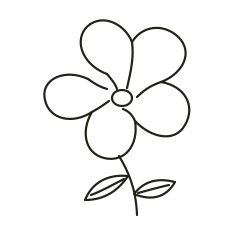
An open wild rose with uneven petal lobes and a small cluster of fine lines at its center.
The petals leave open space around the center. Preserve the breaks that give the bloom its irregular shape.
Vector line art from the Tattoo Stencil collection.
This design concentrates on the outer petal shapes and a small oval center. The bloom covers most of the width, while the two leaves spread from a stem that bends slightly to one side. Compare it with the Tea Rose at the same bloom width. The Tea Rose puts more of the drawing into folds around the center, while the Wild Rose leaves long stretches of open petal. The space makes the two drafts useful comparisons when you are deciding how much internal detail you want.
Test the bloom first, then check the lower part of the stem as its own shape. Set a paper proof beside a version with the leaves simplified to their outer edges. That comparison shows whether the narrow veins help you follow the leaves or compete with the outline. Keep the gaps between the petal bases visible. If those gaps become hard to see, try a larger print before adjusting the little oval.
Use the open flower rather than the stem as the main footprint. Cut a paper window to the width you have in mind and see whether it includes the far left and right petal tips without squeezing either edge. For an upper arm or shoulder mockup, try placing the bloom in the broad part of the paper and letting the stem turn toward the narrower side. Mark the downward leaf separately so you can see whether it changes the overall balance.
Lay the Wild Rose beside a circle drawn to the same bloom width. The petal on the left stretches sideways, while the low petal adds weight beneath the center. Look at which tips fall inside the circle and which reach outside it. This gives you a way to compare the irregular bloom with a rounder rose without mistaking a change in overall size for a change in shape. Keep the circle off the working file and use it as a guide on the comparison sheet only.
At a hypothetical 60 mm width for the square SVG artboard, the 2.2-unit strokes scale to roughly 0.55 mm in the digital file. Use that figure only to identify the draft you are comparing. The visible question is whether the short marks around the center remain detached from the oval. If one begins to read as a spoke touching the oval, shorten it from the center end or omit it while preserving the irregular petal edges.
Choose one narrow gap that matters to the subject, then follow the adjacent lines through the preview. The gap can be more informative than the nominal thickness of either stroke. Keep the main contours and compare one version with fewer inner marks. This makes it easier to see whether the outline or the interior detail needs attention.
Check the small bright pocket beside the lower left petal where its contour turns inward. A print can retain the center oval while losing that notch, which makes the bloom look rounder than the source. Compare the original and proof with the stem pointing the same way. If the notch is present in the file but gone on paper, check the print scale before changing the artwork. If it is already lost in the draft, restore the notch and simplify one interior accent instead.
If the proof fits one sheet, check the usable print area around the far left petal before printing. A page preview can make a bloom look centered even when the stem and leaves pull the visible drawing to one side. If the outline touches the printable margin, shift the artwork on the page or select a larger sheet at the same scale. For a tiled enlargement, keep a complete view of the oval and petal bases on one sheet if the layout allows it. See the actual-size printing guide for calibration and page alignment.
On the paper you choose to share, circle the little leaf that leans toward the right and mark where the stem continues beyond it. Those two features identify the direction more clearly than the nearly oval center does. Record the width across the actual petals as well as the export scale if your file contains blank margins. If you send a simplified version, name which center accents were omitted so the recipient can distinguish that change from a crop or a reversal.